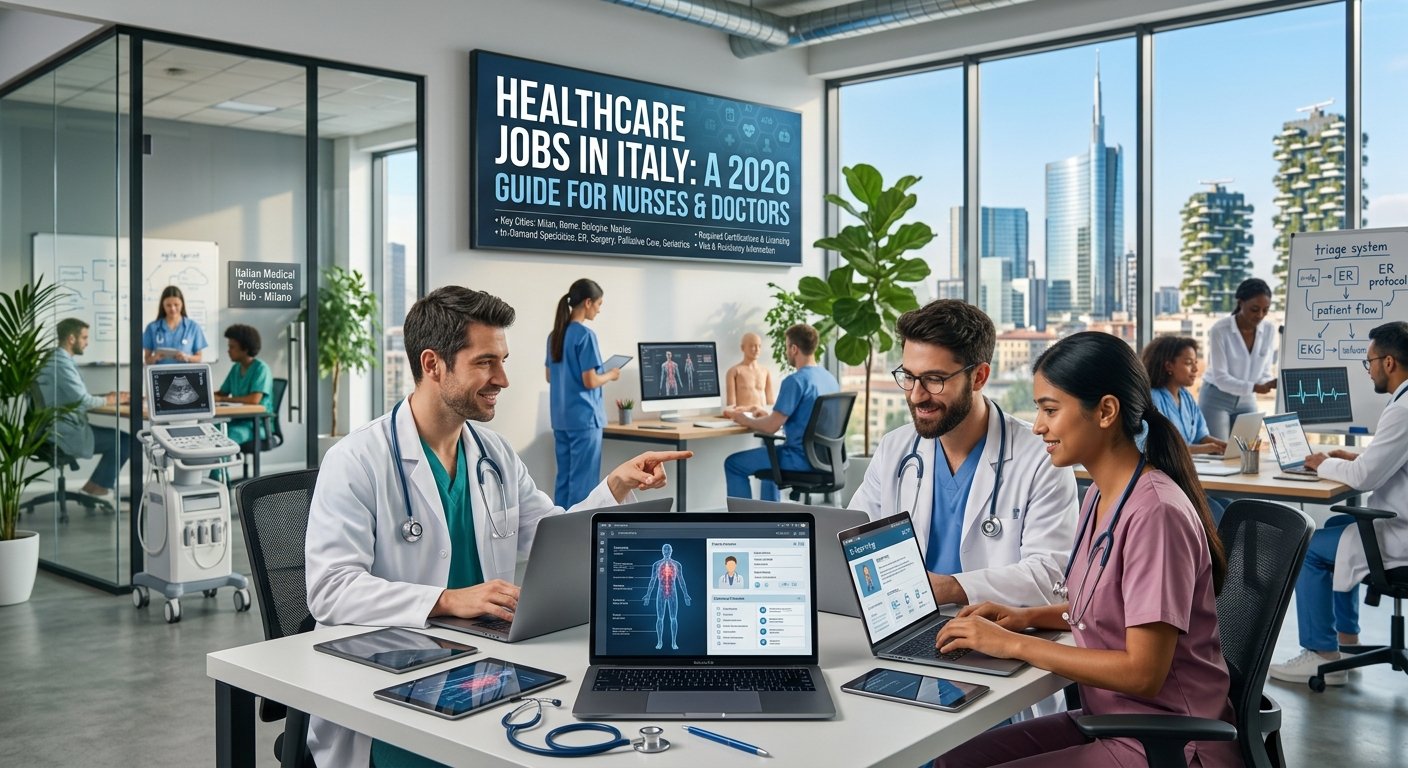
Last updated: August 2026
Explore healthcare jobs in Italy for foreigners in 2026 — demand for nurses and doctors, salaries, visa routes, and credential recognition steps.:
Italy’s healthcare system is facing one of the most significant staffing shortages in its history, and healthcare jobs in Italy for foreigners — especially for nurses and doctors — have become a growing pathway for international medical professionals. An aging population, combined with a shrinking domestic pool of newly qualified nurses, has pushed Italian hospitals and regional health authorities to look beyond national borders to fill critical roles.
This guide covers where the demand is strongest, what nurses and doctors can expect to earn, how credential recognition works, and the visa process for non-EU applicants.
Table of Contents
- Why Italy Needs Foreign Healthcare Workers
- Most In-Demand Healthcare Roles
- Healthcare Salaries in Italy: What to Expect
- Credential Recognition for Nurses and Doctors
- Work Visa Options for Healthcare Professionals
- Best Regions for Healthcare Jobs in Italy
- How to Apply for a Healthcare Job in Italy
- Frequently Asked Questions
Why Italy Needs Foreign Healthcare Workers
Italy has one of the oldest populations in Europe, and that demographic shift is placing sustained pressure on its public health system, the Servizio Sanitario Nazionale (SSN). Hospitals and regional health authorities across the country are reporting shortages of registered nurses and specialist doctors, and international recruitment has become an increasingly common response from Italy’s Ministry of Health and individual hospital trusts.
This isn’t unique to Italy — most of Western Europe is competing for the same pool of internationally trained nurses and physicians. But Italy’s shortage is particularly acute in public hospitals and in regions with older populations, which means genuine opportunities exist for qualified foreign candidates willing to navigate the credential recognition process.
Most In-Demand Healthcare Roles
Demand is not evenly spread across specialties. The roles currently seeing the strongest hiring activity include:
- Registered Nurses (general and specialist) — the single most sought-after healthcare role, with particular need in intensive care, emergency, theatre, and paediatric nursing
- ICU / Critical Care Nurses — consistently in short supply and often better compensated than general nursing roles
- General Practitioners (GPs) — needed especially in smaller towns and rural regions where local doctors are retiring faster than they’re being replaced
- Specialist Physicians — including geriatrics, cardiology, and internal medicine, driven directly by Italy’s aging population
- Elderly Care and Long-Term Care Staff — nurses and care workers supporting Italy’s growing elderly care sector
- Telehealth and Remote Care Professionals — a newer but growing category as Italian healthcare providers expand digital health services
Healthcare Salaries in Italy: What to Expect
Italian healthcare salaries are generally modest compared to Northern European countries like Germany or the Netherlands, but the cost of living outside major cities can offset that difference. Typical gross annual ranges for 2026:
| Role | Entry-Level | Experienced | Specialist |
|---|---|---|---|
| Registered Nurse | €24,000–€28,000 | €28,000–€35,000 | €35,000–€42,000 (ICU/specialist) |
| General Practitioner | €35,000–€45,000 | €45,000–€60,000 | — |
| Hospital Specialist Physician | €45,000–€60,000 | €60,000–€85,000 | €85,000+ (senior consultant) |
| Elderly Care Nurse | €22,000–€27,000 | €27,000–€32,000 | — |
Doctors who combine public hospital work with private practice generally earn more than those working exclusively within the public system. Salaries are also noticeably higher in Northern Italy, particularly Lombardy, than in the South.
Credential Recognition for Nurses and Doctors
Before working in Italy, foreign-trained nurses and doctors must have their medical qualifications formally recognized. This is one of the most important — and often most time-consuming — steps in the process.
- Degree recognition — your nursing or medical degree must be assessed and recognized by Italy’s Ministry of Health.
- Professional registration — nurses register with the relevant Ordine delle Professioni Infermieristiche (nursing council), while doctors register with the Ordine dei Medici (medical council) in their province of employment.
- Language requirement — a demonstrable level of Italian is typically required, since patient communication is central to both nursing and medical practice. Some hospitals may accept candidates with a language plan in place, but functional Italian is expected fairly early in employment.
- EU vs. non-EU applicants — EU citizens can generally work in Italy without a visa but still need degree recognition and language proof. Non-EU citizens need both credential recognition and a sponsored work visa.
Because this process varies by region and profession, it’s worth starting the recognition process well before applying to specific hospital vacancies.
Work Visa Options for Healthcare Professionals
Non-EU nurses and doctors typically need employer sponsorship to work legally in Italy. The main pathways include:
- Nulla Osta Work Authorization — the Italian employer applies for this work authorization on the candidate’s behalf; it’s a required step before a work visa can be issued.
- Decreto Flussi (Skilled Worker Quota) — Italy’s annual quota system for foreign workers, which healthcare employers can use to sponsor nursing and medical staff, subject to the yearly allocation.
- EU Blue Card — available to highly qualified professionals, including specialist doctors, whose role and salary meet the qualifying threshold.
- Regional Health Authority Recruitment Programs — some Italian regions run direct recruitment drives for nurses, occasionally including relocation or credential-recognition support.
Because visa routes depend heavily on the hiring hospital or region, confirming sponsorship and the specific authorization route early in the application process saves significant time.
Best Regions for Healthcare Jobs in Italy
- Lombardy (Milan) — Italy’s largest healthcare system, with the highest salaries and the greatest concentration of specialist hospital positions
- Lazio (Rome) — strong demand across public hospitals and private clinics, with a large international patient base
- Emilia-Romagna — known for well-regarded public hospitals and steady nursing demand
- Veneto and Piedmont — growing elderly care and general nursing demand, often with a lower cost of living than Milan or Rome
- Southern Italy and smaller towns — frequently the areas with the most acute GP and rural doctor shortages, sometimes with additional incentives for relocating professionals
How to Apply for a Healthcare Job in Italy
- Start credential recognition early — this is often the longest step, so begin the Ministry of Health assessment before actively job hunting.
- Build conversational Italian — even basic-to-intermediate Italian meaningfully improves your chances, since patient-facing roles require it.
- Target hospitals and regions with active recruitment programs — some regional health authorities recruit internationally on a rolling basis.
- Work with recognized recruitment agencies — agencies that specialize in EU healthcare placements can help navigate registration and visa sponsorship.
- Confirm the visa route with your employer upfront — ask specifically whether they will handle the Nulla Osta and Decreto Flussi application before accepting an offer.
- Prepare full documentation early — degree certificates, registration proof, and language certification are commonly requested together, so having them ready speeds up hiring.
Frequently Asked Questions
Are healthcare jobs in Italy in demand for foreigners in 2026? Yes. Italy’s aging population and shortages in public hospital staffing, particularly for nurses and specialist doctors, are driving increased international recruitment.
Do foreign nurses and doctors need to speak Italian to work in Italy? In almost all cases, yes. Patient-facing healthcare roles require functional Italian, and hospitals typically expect at least a working level of the language, even if a formal language plan is allowed during onboarding.
How much do nurses earn in Italy? Registered nurses typically earn between €24,000 and €35,000 gross per year, with ICU and specialist nurses earning up to around €42,000, depending on region and experience.
What visa do non-EU doctors and nurses need to work in Italy? Most non-EU healthcare professionals need a Nulla Osta work authorization sponsored by an Italian employer, followed by a work visa. Specialist doctors may qualify for the EU Blue Card if the role and salary meet the threshold.
Which region in Italy has the most healthcare job opportunities? Lombardy, home to Milan, has Italy’s largest healthcare system and the highest concentration of hospital jobs, though rural regions in the South often have the most acute shortages of general practitioners.