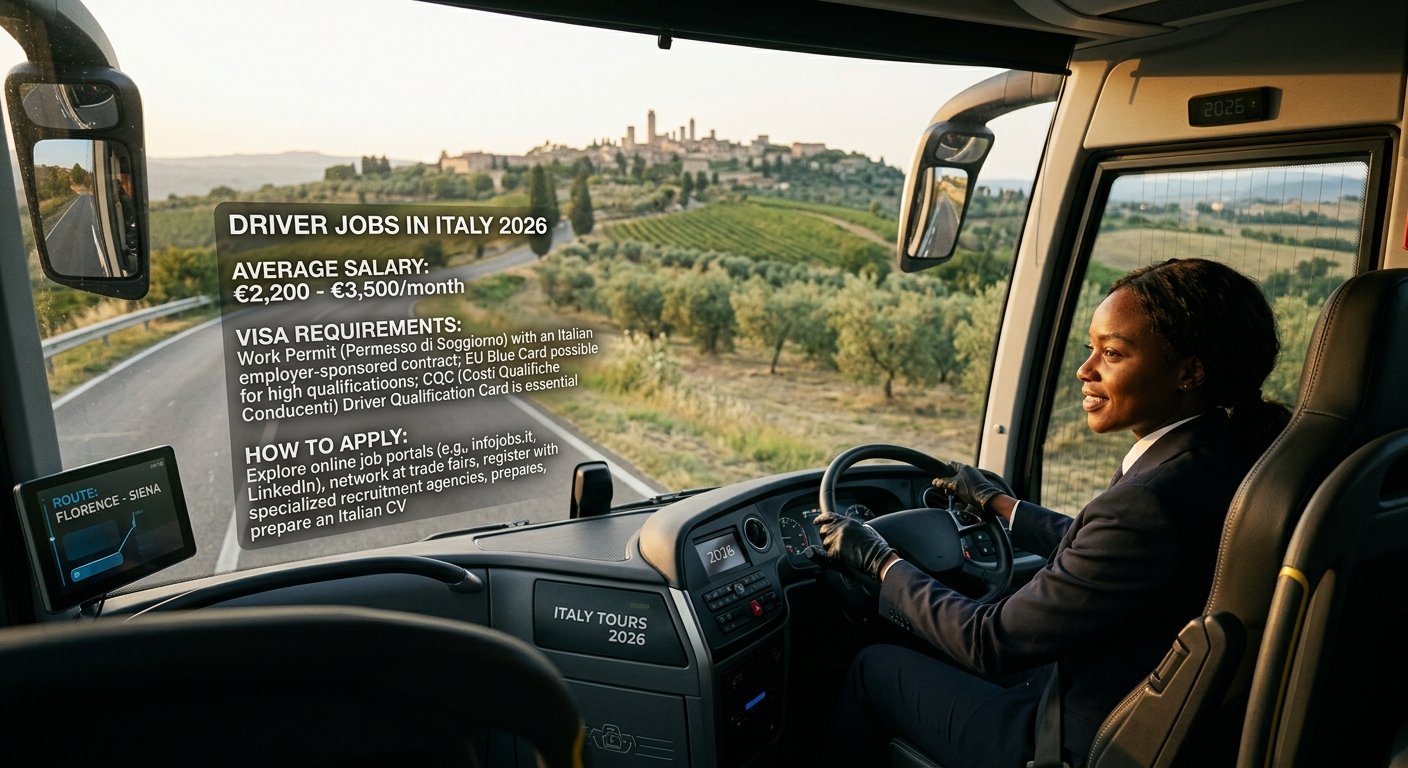
Last updated: August 2026
Italy’s transport and logistics sector is one of the most active hiring markets for foreign workers in 2026. Driven by e-commerce growth, an aging domestic workforce, and a shortage of licensed heavy-vehicle operators, driver jobs in Italy — from delivery riders to long-haul truck drivers — are consistently listed as in-demand roles by Italian labour authorities.
This guide breaks down the real salary ranges, the documents you need, how Italy’s work visa quota (Decreto Flussi) applies to drivers, and the practical steps to apply — whether you’re an EU citizen or applying from abroad.
Disclosure: This article is for general informational purposes only and is not legal or immigration advice. Visa rules, quotas, and employer requirements change frequently. Always confirm current requirements with the Italian Ministry of Labour or your nearest Italian consulate before making decisions.
Why Driver Jobs in Italy Are in High Demand
Italy’s road transport network connects Northern Europe, the Mediterranean, and the Balkans, making it one of the busiest freight corridors in the EU. A few factors are pushing demand for drivers higher in 2026:
- E-commerce growth — more parcels moving through last-mile delivery networks in cities like Milan, Rome, Turin, and Bologna.
- An aging driver workforce — many licensed Italian truck drivers are nearing retirement, and fewer young Italians are entering the profession.
- New logistics hubs — continued investment in warehousing and distribution centers across northern Italy.
- EU-wide driver shortage — Italy competes with Germany, France, and the Netherlands for qualified HGV (heavy goods vehicle) drivers, which keeps demand — and in some cases wages — competitive.
Types of Driver Jobs Available in Italy
“Driver jobs” covers a wide range of roles, each with different licensing and experience requirements.
1. Truck Drivers (HGV / Long-Haul)
Long-distance and international freight drivers, often holding a Category CE license. These roles typically pay the most due to travel allowances and overtime.
2. Local & Regional Delivery Drivers
Drivers moving goods within a city or region, usually on fixed daily routes with more predictable hours than long-haul work.
3. Van & Last-Mile Delivery Drivers
Roles tied to e-commerce and courier companies, delivering parcels to homes and businesses. These often require only a standard Category B license.
4. Bus and Public Transport Drivers
Positions with municipal transport authorities or private coach companies, requiring a Category D license and a passenger transport certificate (CQC).
5. Private and Corporate Drivers
Chauffeur-style roles for companies, hotels, or private clients, usually requiring a clean driving record and strong customer-service skills.
Requirements to Work as a Driver in Italy
Employers and Italian immigration authorities generally expect the following:
- A valid driving license matching the vehicle category (B, C, CE, or D), either an EU license or one that can be exchanged/recognized under Italian rules
- A CQC certificate (Carta di Qualificazione del Conducente) for professional truck and bus drivers
- A clean driving record / police clearance certificate
- Basic Italian language skills — helpful for local delivery and required for most bus/transit roles; some logistics and multinational employers accept English speakers
- A medical fitness certificate, especially for HGV and passenger-transport roles
- A valid passport and, for non-EU applicants, a work visa or residence permit
Work Visa Rules for Non-EU Drivers (Decreto Flussi)
EU/EEA citizens can work in Italy without a visa. Non-EU nationals need a work permit issued through Italy’s Decreto Flussi (Flow Decree), the annual quota system that regulates foreign labour admissions.
Key points for 2026:
- The quota system allocates a set number of work visas each year, and employers must apply for sponsored workers during designated “Click Days.”
- A job offer from an Italian employer is required first — you cannot apply for this visa independently.
- Transport, logistics, and delivery roles are among the sectors regularly included in shortage-occupation lists published by ANPAL (Italy’s National Agency for Active Labour Policies) and EURES Italy.
- Once approved, the worker receives a residence permit tied to the job, which can lead toward longer-term residency if renewed and maintained according to immigration rules.
Because quotas and application windows change every year, always check the latest figures on the official Ministry of Labour or EURES Italy portals before applying.
Driver Salaries in Italy (2026)
Salaries vary significantly by role, region, and experience level. Based on 2026 industry salary data:
| Driver Role | Typical Gross Monthly Salary | Typical Gross Annual Salary |
|---|---|---|
| Entry-level truck driver | €1,800 – €2,200 | €25,000 – €28,000 |
| Experienced HGV / long-haul driver | €2,300 – €3,000 | €30,000 – €37,000 |
| Senior / specialized driver (8+ yrs) | €2,800 – €3,300 | €35,000 – €39,000 |
| Local delivery / last-mile driver | €1,600 – €2,000 | €19,000 – €24,000 |
Net (take-home) pay is typically 25–35% lower than gross salary after Italian tax and social contributions. Long-haul and international routes tend to pay more due to per-diem allowances, ADR (hazardous goods) premiums, and overtime, which can add 20–50% on top of base salary. Many companies also pay a customary 13th-month salary, standard practice across Italy.
Salary ranges are approximate and compiled from publicly available 2026 salary survey data (Glassdoor, SalaryExpert, and industry reports). Actual pay depends on employer, contract type, and region.
Where to Find Driver Jobs in Italy
- EURES Italy — the EU’s official cross-border job portal, listing verified logistics and transport vacancies
- ANPAL (Agenzia Nazionale Politiche Attive del Lavoro) — Italy’s national labour agency and shortage-occupation lists
- Company career pages of major logistics firms operating in Italy (postal services, courier networks, freight carriers)
- Licensed recruitment agencies that specialize in EU work-visa sponsorship — verify any agency’s credentials before paying any fee, and never pay for a “guaranteed” job offer
How to Apply: Step-by-Step
- Get your documents in order — passport, driving license, CQC certificate (if applicable), medical certificate, and police clearance.
- Search verified job boards such as EURES and ANPAL, or licensed logistics recruiters.
- Apply directly with a tailored CV highlighting your license category, years of experience, and any international driving experience.
- Secure a written job offer from a registered Italian employer before pursuing any visa paperwork.
- Have your employer apply for sponsorship during the relevant Decreto Flussi Click Day window, if you’re a non-EU applicant.
- Complete visa and residence permit formalities at your local Italian consulate once the offer and sponsorship are confirmed.
Frequently Asked Questions
Do I need to speak Italian to work as a driver in Italy? Basic Italian helps with local delivery and is generally required for bus and public-transport roles. Some international logistics and courier companies accept English-speaking drivers, especially for long-haul EU routes.
Can foreigners get visa sponsorship for driver jobs in Italy? Yes, but sponsorship depends on the employer and the annual Decreto Flussi quota. A confirmed job offer from an Italian employer is required before a work visa can be processed.
What license do I need to drive a truck in Italy? Professional truck drivers typically need a Category C or CE license plus a CQC (Carta di Qualificazione del Conducente) professional certificate. Requirements can vary depending on the vehicle and whether goods or passengers are being transported.
How much do truck drivers earn in Italy in 2026? Gross salaries typically range from about €25,000 to €37,000 per year, depending on experience, route type, and region, with long-haul and specialized drivers earning at the higher end.
Is Italy a good country for foreign drivers to work in? Italy offers steady demand for drivers, EU labour protections, and a path toward longer-term residency for sponsored workers, though wages are moderate compared to Northern European countries like Germany or the Netherlands.
Final Thoughts
Driver jobs in Italy offer a realistic path to stable employment for both EU citizens and non-EU applicants willing to navigate the work-visa process. Focus on securing the right license and certifications, apply through verified channels like EURES and ANPAL, and confirm every visa detail with official Italian sources before committing to a job offer.